How to Get Visible in ChatGPT, Gemini & Google AI: GEO and AI Search for Businesses in 2026
Someone looking for the best CRM software for a mid-sized company, an AI production studio for a commercial or the right camera for a particular project no longer has to work through ten blue Google links.
They can simply ask ChatGPT, Gemini or Google AI.
The system researches.
It compares.
It summarises.
And, in the best case, it names only a handful of specific providers, brands or sources.
That creates a new kind of digital competition for businesses.
The traditional goal was:
“We want to rank on page one of Google.”
Today, there is a second question:
“Do AI systems even recognise us as a relevant brand?”
This shift is already much bigger than a niche SEO development. In May 2026, Google reported more than 2.5 billion monthly active users for AI Overviews. AI Mode had already passed one billion monthly active users.
User behaviour is changing as well. A recent Pew Research Center survey found that 60% of U.S. adults say they already read AI summaries in search engines.
At the same time, ChatGPT is evolving from a chatbot into a research, search and commerce interface. ChatGPT Search can research and link to current web sources, while merchants can now provide structured product feeds so their products can be represented in relevant shopping experiences.
Welcome to GEO.
Or AEO.
Or LLMO.
Or AI Search Optimization.
Naturally, the marketing industry has already invented several acronyms for essentially the same problem. It needed something to do.
The terminology matters less than the real question:
What actually works?
What Is Generative Engine Optimization?
Generative Engine Optimization, or GEO, describes efforts designed to increase the visibility of a brand, website or its content inside generative search and answer systems.
These include:
- Google AI Overviews
- Google AI Mode
- ChatGPT Search
- Gemini
- Perplexity
- Copilot
- AI-powered shopping and research agents
In traditional SEO, the central journey often looks like this:
Keyword → Ranking → Click
Generative search works differently:
Question → Research → Synthesis → Answer → Sources and recommendations
A business can therefore appear in an AI system in at least three different ways:
- As a source: its website is cited or linked as evidence for a statement.
- As a brand: the company is named directly inside the answer.
- As a recommendation: the company or product is suggested as a specific option.
These are not the same thing.
A Semrush analysis published in June 2026 illustrates the difference. Approximately 61.7% of the AI citations studied were “ghost citations”: the website was used as a source, but the brand itself was never mentioned in the generated answer. Only 13.2% of appearances contained both a citation and a brand mention.
That changes the way we need to think about visibility.
A link is no longer the only objective.
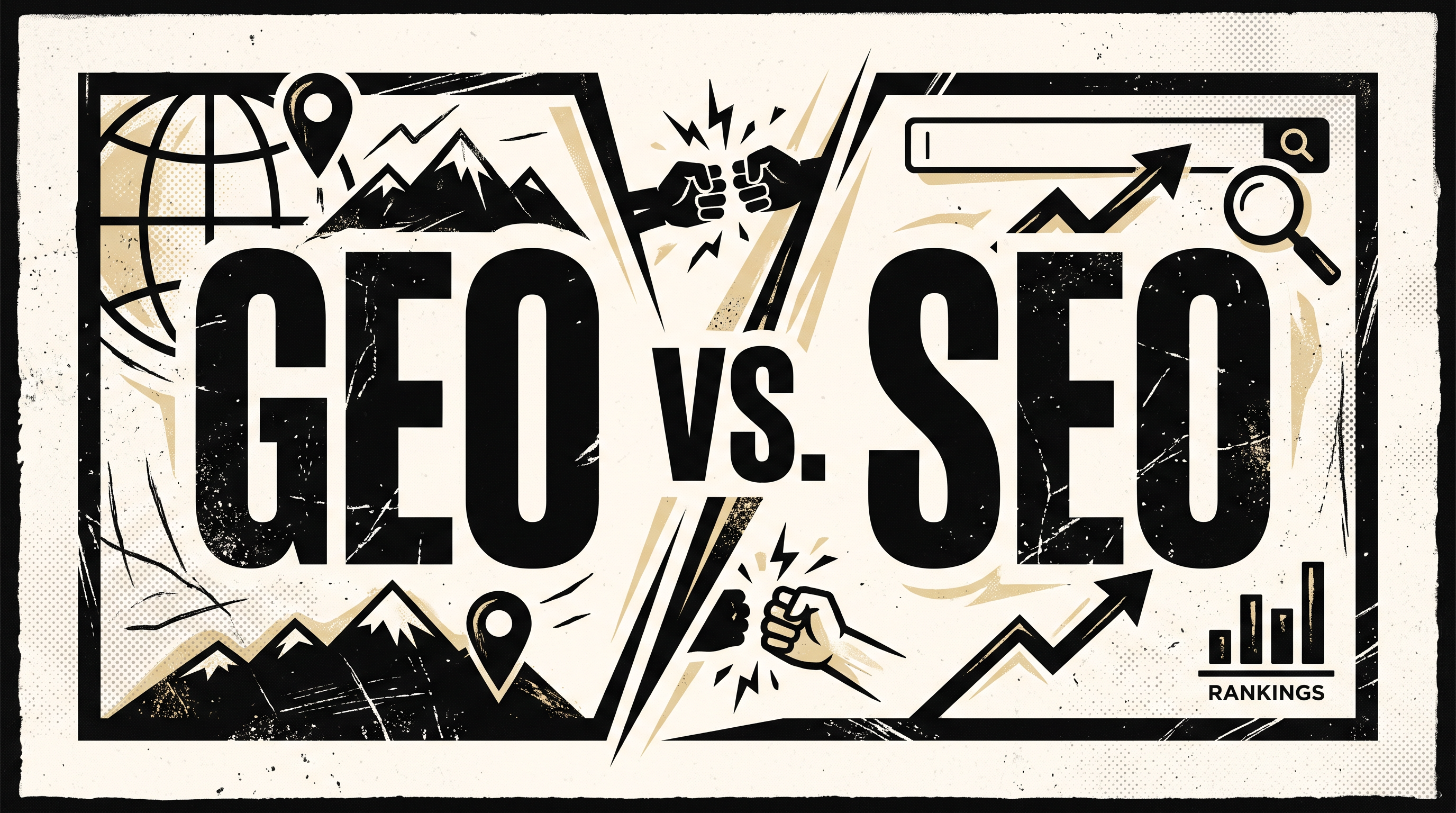
Is GEO Simply the New SEO?
Yes and no.
Google is surprisingly clear on this question.
In May 2026, Google published a detailed guide to optimisation for generative AI search experiences. Its central message was simple:
Good SEO remains the foundation.
AI Overviews and AI Mode still depend on Google's Search index, ranking systems and quality systems. From Google's perspective, GEO and AEO therefore remain part of modern SEO rather than completely separate disciplines.
A site that cannot be crawled, contains weak content and has built no authority does not suddenly gain a secret back door into Gemini.
However, generative search still changes the rules.
Traditional search results and AI-generated answers are assembled differently.
An Ahrefs study of 15,000 long-tail queries found that only around 11% of URLs cited by ChatGPT, Gemini, Copilot and Perplexity also ranked in the top ten results in Google or Bing for the original question.
Strong traditional SEO therefore helps.
But ranking third does not guarantee an AI citation.
And an AI citation does not necessarily require ranking third.
How AI Search Finds Information
To approach GEO strategically, it helps to understand that AI Search is not simply “Google with longer answers”.
Google describes two mechanisms that are particularly relevant to its generative search systems.
Retrieval-Augmented Generation
With Retrieval-Augmented Generation, or RAG, a model does not answer exclusively using knowledge encoded during training.
It retrieves current sources and uses them to ground its response.
That matters because websites can potentially appear around topics that change continuously.
The requirement is straightforward:
The system needs to find, understand and consider the content relevant.
Query Fan-Out
Google's query fan-out is even more interesting.
A complex user question can internally trigger multiple related searches.
A question such as:
Which CRM is suitable for a small German marketing agency that needs HubSpot integration and strong GDPR compliance?
could conceptually trigger research around:
- CRM for small marketing agencies
- CRM HubSpot integration
- GDPR CRM Germany
- CRM agency comparison
- best CRM for small teams
The system therefore does not necessarily research only the exact wording of the original prompt. It investigates the wider information space behind the question.
That has major implications for content strategy.
A page does not need to repeat 35 keyword variations.
It needs to cover a subject with enough depth to remain relevant across multiple related questions.
The 8 Most Important Factors for AI Search Visibility
There is no guaranteed formula for ranking inside ChatGPT.
Anyone selling one either has unprecedented access to internal OpenAI and Google systems or an unusually optimistic sales department.
However, official documentation and large datasets do reveal clear priorities.
1. Technical Discoverability Remains the Foundation
We begin with the boring part.
Unfortunately, it matters.
For Google, a page still needs to be crawlable, indexable and otherwise eligible for Search in order to be considered for generative search features.
That includes fundamentals such as:
- correct HTTP status codes
- no accidental
noindexdirectives - sensible robots.txt rules
- correct canonicals
- crawlable internal linking
- fast and mobile-friendly pages
- accessible primary content
- properly implemented JavaScript
- clear URL structures
- XML sitemaps
For ChatGPT, there is an additional consideration.
OpenAI operates its own search crawler called OAI-SearchBot. According to OpenAI, websites that block the bot through robots.txt will not appear as sources in ChatGPT Search answers, although they may still appear as navigational links.
It is important to distinguish this from GPTBot:
OAI-SearchBot is used for Search. GPTBot relates to model training.
A website can therefore allow ChatGPT Search while simultaneously opting out of training. OpenAI treats the two controls independently.
This is a surprisingly common technical oversight.
2. Create Content Worth Citing
Google uses an excellent phrase in its 2026 AI Search documentation:
Non-commodity content.
It describes content that does not merely repeat information already available across hundreds of other websites.
Google specifically points toward:
- first-hand experience
- unique perspectives
- expert knowledge
- original information
- genuinely useful and reliable content
and advises against simply recycling what others on the web have already said.
This becomes even more important in GEO than in traditional SEO.
Why should an AI system cite your site if it contains exactly the same information as 400 others?
An article titled
“10 Benefits of Artificial Intelligence in Marketing”
adds almost no new information.
An article such as
“What Our First 25 AI Video Productions Taught Us About Character Consistency”
contains something no other source can provide.
Particularly valuable assets include:
- proprietary data
- original experiments
- industry benchmarks
- case studies
- detailed processes
- expert analysis
- original imagery and video
- practical tests
- interviews
- transparent comparisons
This is more than content marketing.
It is source building.
3. Do Not Just Cover Topics. Become the Source for Specific Claims.
Traditional SEO content was often built around keywords.
AI Search places greater value on a page's ability to answer specific sub-questions clearly.
Instead of simply targeting:
“AI video production”
a strong article should also contain reliable answers to questions such as:
- How much does professional AI video production cost?
- When is AI cheaper than live-action?
- Where do product-consistency problems occur?
- Which production stages still require people?
- What needs to be disclosed under the EU AI Act?
- When is hybrid production better?
How these answers are written matters.
Definitions should be clear.
Numbers need context.
Claims need evidence.
Comparisons should be understandable.
Paragraphs should communicate concrete ideas.
Not because an LLM can only understand three-sentence chunks. Google explicitly says there is no requirement to artificially “chunk” content for generative search.
But because strong information architecture helps humans and machines.
4. Brand Mentions Are Becoming More Important
SEO spent decades focusing heavily on links.
AI systems also need to understand:
Which brands are associated with which topics?
A large Ahrefs study covering 75,000 brands found strong correlations between branded web mentions and visibility across ChatGPT, Google AI Mode and AI Overviews. Mentions on YouTube showed a particularly strong correlation with AI visibility.
This does not establish direct causation.
A well-known brand will naturally be mentioned more frequently and will also be more likely to appear in AI responses.
Nevertheless, the strategic implication matters:
A brand should not exist only on its own website.
It should exist throughout the digital ecosystem surrounding its expertise.
For example:
- industry publications
- podcasts
- YouTube videos
- professional directories
- interviews
- conferences
- partner case studies
- reviews
- communities
- credible comparison articles
This begins to look a lot like traditional PR.
Except PR now has an additional Search function.
5. YouTube Is Becoming More Interesting for AI Visibility
One surprising result from the Ahrefs research:
Of all the signals analysed, YouTube mentions showed the strongest statistical correlation with AI visibility across ChatGPT, AI Mode and AI Overviews.
That does not mean:
“Upload three videos and ChatGPT will recommend you.”
It does suggest that businesses should stop thinking about Search exclusively as a website strategy.
For complex B2B products and services, useful formats include:
- expert interviews
- tutorials
- case breakdowns
- product comparisons
- behind-the-scenes content
- webinars
- conference talks
- how-to videos
Google's own current guidance also notes that relevant images and video can provide additional opportunities to appear in generative Search experiences.
Search is becoming multimodal.
SEO needs to become multimodal too.
6. Build a Clear Entity
An AI system should have as little ambiguity as possible about:
- what your business is called
- what it offers
- which industry it belongs to
- where it operates
- who is behind it
- which expertise it has
- which products and services belong together
Traditional entity-SEO foundations therefore remain relevant:
- a clear About page
- author profiles
- team pages
- consistent company descriptions
- reliable contact information
- Organization structured data
- Person structured data
- clear product and service information
- consistent social profiles
- Google Business Profile for local companies
- Merchant Center for ecommerce
Google specifically identifies Business Profile and Merchant Center as important ways of supplying business and product information that can surface in generative results.
OpenAI is moving in a similar direction: merchants can provide structured product feeds so ChatGPT can accurately display current information such as price and availability.
For ecommerce, GEO is therefore increasingly becoming data optimisation as well.
7. Third-Party Authority Is Harder to Control and Therefore More Valuable
If your own website says:
We are Germany's most innovative artificial intelligence agency.
that is, initially, a claim.
If five independent industry publications mention GOODARTSY in the context of professional AI production, that is an external signal.
This is why earned media becomes particularly interesting for AI Search.
It is also already producing questionable tactics.
In the summer of 2026, The Verge reported that marketers were attempting to insert apparently organic brand mentions into Reddit discussions because community content is frequently surfaced by AI search systems. Reddit moderators have consequently had to combat sock-puppet accounts and covert promotional posts.
That is not sustainable GEO.
Google now explicitly warns against pursuing inauthentic mentions and notes that its spam systems remain relevant to generative Search features.
The better strategy is less exciting:
Be worth mentioning.
Then make sure relevant people know about it.
8. Freshness Becomes a Competitive Advantage for Certain Topics
Generative search systems can retrieve current web sources.
That changes fast-moving topics such as:
- technology
- software
- law
- marketing
- finance
- products
- pricing
- science
- trends
An excellent 2024 article about AI video may still have been genuinely expert.
In 2026, it may also be completely outdated.
Important content should therefore be reviewed regularly:
- Are models and product names still current?
- Are prices accurate?
- Have regulations changed?
- Do the features still exist?
- Are the statistics current?
- Are there stronger recent cases?
Evergreen content does not mean:
write once and forget.
It means:
maintain one authoritative URL over time.
The Big GEO Trap: More Content Does Not Automatically Mean More Visibility
Generative AI has made content production extremely cheap.
That creates an obvious temptation:
Why not produce 5,000 landing pages?
One for every industry.
Every city.
Every question.
Every prompt variation.
Because that will probably become a fairly poor long-term strategy.
Google explicitly warns against producing pages for every possible query fan-out variation. Doing so primarily to manipulate visibility can violate its scaled content abuse policies.
Data also fails to support the idea that more pages automatically create more AI visibility.
In Ahrefs' analysis of 75,000 brands, the relationship between overall page count and AI visibility was very weak.
The stronger strategy is:
fewer, more information-dense assets.
One outstanding guide containing proprietary data, expert knowledge, examples, imagery and video is likely to be more valuable than 25 posts repeating the same information under slightly different headlines.
Humans tend to appreciate that as well. A convenient side effect.
Do I Need an llms.txt File?
The short answer:
Not for Google.
In 2026, Google explicitly clarified that Google Search does not use llms.txt as a ranking or generative Search signal.
The same applies to supposed special “AI markup” or AI-specific Markdown files.
An llms.txt file may still serve other systems or experimental use cases.
It is not a magic GEO switch.
If the choice is between:
spending three days perfecting llms.txt
or
publishing an outstanding original case study
we would choose the case study.
Every time.
Do I Need Special Schema Markup for ChatGPT or Google AI?
Again:
No.
Google explicitly states that there is no special structured data markup required for AI Overviews or AI Mode.
Structured data remains useful.
Not as a GEO hack, but because well-structured information can help search systems understand real entities such as products, organisations, articles, events or local businesses.
The rule should therefore be:
Use schema when it accurately describes the real content.
Not:
Invent schema because a LinkedIn post claimed Gemini has a particular fondness for JSON-LD.
Traditional Ranking vs. AI Citation vs. Brand Mention
Businesses need to understand one more important distinction.
Ranking
Your website appears in traditional search results.
Citation
Your website is used as a source by an AI system.
Brand Mention
The AI system names your company directly in the answer.
Recommendation
The AI system actively recommends your company as an option.
These should be measured separately.
A business can:
- receive many citations but very few brand mentions
- be frequently mentioned but rarely linked
- have strong organic traffic but remain almost invisible in ChatGPT
- appear regularly in AI comparisons without being used as the source
The Semrush study mentioned earlier demonstrates how far citations and mentions can diverge.
A single KPI such as “organic traffic” is therefore increasingly insufficient for modern Search reporting.
How Do You Measure GEO and AI Visibility in 2026?
Measurement is still considerably weaker than traditional SEO.
But it is improving.
1. Google Search Console
In June 2026, Google introduced dedicated Generative AI Performance Reports in Search Console.
They include data such as:
- impressions within generative features
- visible URLs
- countries
- devices
- visibility over time
Google is initially rolling these reports out to only a subset of websites. AI Mode data also continues to contribute to general Search performance reporting.
This is an important step.
For the first time, website owners can isolate parts of their generative Google Search visibility using first-party data.
2. Referral Traffic
Analytics platforms can separately analyse visitors from sources such as ChatGPT or Perplexity.
Sessions alone are not the most interesting metric.
Look at:
- conversion rate
- lead rate
- engagement
- revenue
- assisted conversions
Semrush reported in 2026 that, based on its own research, AI Search visitors can show substantially higher average conversion value than traditional organic visitors. Results will vary significantly by industry and should not be treated as a universal benchmark, but the finding illustrates why relatively small volumes of AI referral traffic may still have commercial value.
3. Prompt Monitoring
Define realistic questions potential customers might ask.
For example:
- Which AI agencies operate in Germany?
- Which production studios create AI commercials?
- Who produces AI product videos?
- Which agencies combine live-action and generative AI?
- Which companies provide GenAI workshops for marketing teams?
Then monitor:
- Are we mentioned?
- Which competitors are mentioned?
- Which sources are cited?
- How is our brand described?
- Which topics are missing?
One caveat matters:
AI outputs are probabilistic and constantly changing.
One prompt on one day is not a reliable KPI.
Measurement needs repetition.
Fewer Clicks, But Potentially Better Clicks
AI Search is also changing the value of traditional website traffic metrics.
An analysis by Pew Research Center based on the browsing behaviour of 900 U.S. adults found:
When a Google AI summary appeared, users clicked a traditional search result in only 8% of visits studied.
Without an AI summary, they clicked a traditional result in 15% of visits.
Links inside the AI summary itself were clicked in only around 1% of visits.
Google presents a more positive interpretation of the change, arguing that AI Search creates additional queries and that visits generated through its AI experiences can represent higher-quality clicks.
Both perspectives can matter simultaneously.
Fewer people need to click to receive an initial answer.
Those who still click may already have considerably more context and stronger intent.
For businesses, that means:
Traffic alone becomes a weaker KPI.
More meaningful measures include:
- qualified leads
- conversion rate
- branded search
- brand mentions
- share of voice
- recommendations
- revenue
Ten thousand informational visitors may be commercially less valuable than 300 people who arrive after an AI assistant has already positioned your company as an appropriate solution.
GEO for B2B Companies: What We Would Actually Do
For a B2B company, we would not treat GEO as an isolated side project in 2026.
We would connect SEO, content, PR and brand.
Step 1: Define Topic Authority
Which five to ten subjects should the brand genuinely be known for?
Not 200.
Five to ten.
For GOODARTSY, these might include:
- AI Video Production
- AI Advertising
- Generative Content Production
- Hybrid Production
- AI Product Visualization
- Creative AI Workflows
Step 2: Audit Existing Visibility
For central commercial and research prompts, analyse:
- ChatGPT
- Gemini
- Google AI Mode
- Google AI Overviews
- Perplexity
Which companies are currently recommended?
Which websites are cited?
Which content types dominate?
Step 3: Identify Source Gaps
If competitors are appearing and your brand is not:
Why?
Are you missing:
- an authoritative guide?
- proprietary research?
- a case study?
- a comparison page?
- external media coverage?
- YouTube presence?
- a clear entity footprint?
- technical crawler access?
Step 4: Produce Source-Worthy Content
Then do not simply publish more blog posts.
Create things that others need to cite if they want to cover the topic seriously.
For example:
- industry studies
- proprietary benchmarks
- transparent experiments
- detailed cases
- tools
- calculators
- templates
- datasets
- expert interviews
- visual analyses
Step 5: Build Distribution
An outstanding article without distribution remains an outstanding article nobody knows exists.
Use:
- PR
- YouTube
- newsletters
- industry media
- podcasts
- partners
- communities
- events
Not as a link-building trick.
As a way to build genuine subject-matter presence.
Step 6: Measure and Update
Track:
- rankings
- Search Console
- AI visibility
- citations
- brand mentions
- referral traffic
- leads
- branded search
- conversions
And update content when the information environment changes.
GEO Is Ultimately Brand Building With Technical Infrastructure
Perhaps the most interesting thing about AI Search is that it makes SEO more like marketing again.
Many traditional SEO tactics could be executed in isolation.
A company could achieve strong rankings without being particularly well known outside its own website.
Generative search makes that separation more difficult.
AI systems investigate:
What does your website say?
What do other sources say?
Where is your brand mentioned?
What experiences do people report?
Which products are compared?
Which experts stand behind the company?
Which information is current?
Disciplines that companies spent years treating separately suddenly begin to converge:
SEO + PR + Content + Social + Video + Brand + Structured Data
GEO is therefore less a completely new marketing channel than a new layer across existing channels.
Conclusion: The Future of SEO Is Not “Writing for Machines”
The wrong reaction to AI Search would be rewriting all content for LLMs.
The better response is almost the opposite.
The better search systems become at summarising existing information, the less valuable interchangeable content becomes.
Nobody needs the 846th version of:
“What is artificial intelligence?”
An AI system can formulate that answer itself.
What it does not inherently possess are:
- your data
- your experience
- your projects
- your customer cases
- your expertise
- your experiments
- your perspective
That is where digital authority will increasingly come from.
Google makes this unusually explicit in its current guidance: businesses should create unique, valuable, non-commodity content rather than reproducing information that generative AI could easily produce itself.
That may be the best GEO strategy available in 2026.
Do not write for AI.
Create something AI wants to cite.